SEO Made Simple: The 6-Pillar System Top Experts Use to Rank on Page 1 of Google

SEO Made Simple: The 6-Pillar System Top Experts Use to Rank on Page 1 of Google
Most marketers think SEO is complicated: that you have to be a tech wizard to do it effectively. But the truth is, for such a powerful user acquisition channel, it’s surprisingly straightforward.
All you need is a proven, repeatable framework, and the discipline to consistently execute and refine it over time. SEO takes patience, but the payoff is huge: tons of free, high-intent organic traffic.
After years of hands-on SEO work, I’ve distilled below the exact strategies used by the top 2–3% of SEO experts. If you apply them to your business and stick with it for 4–6 months, you’ll start ranking on the first page of Google for many of your keywords.
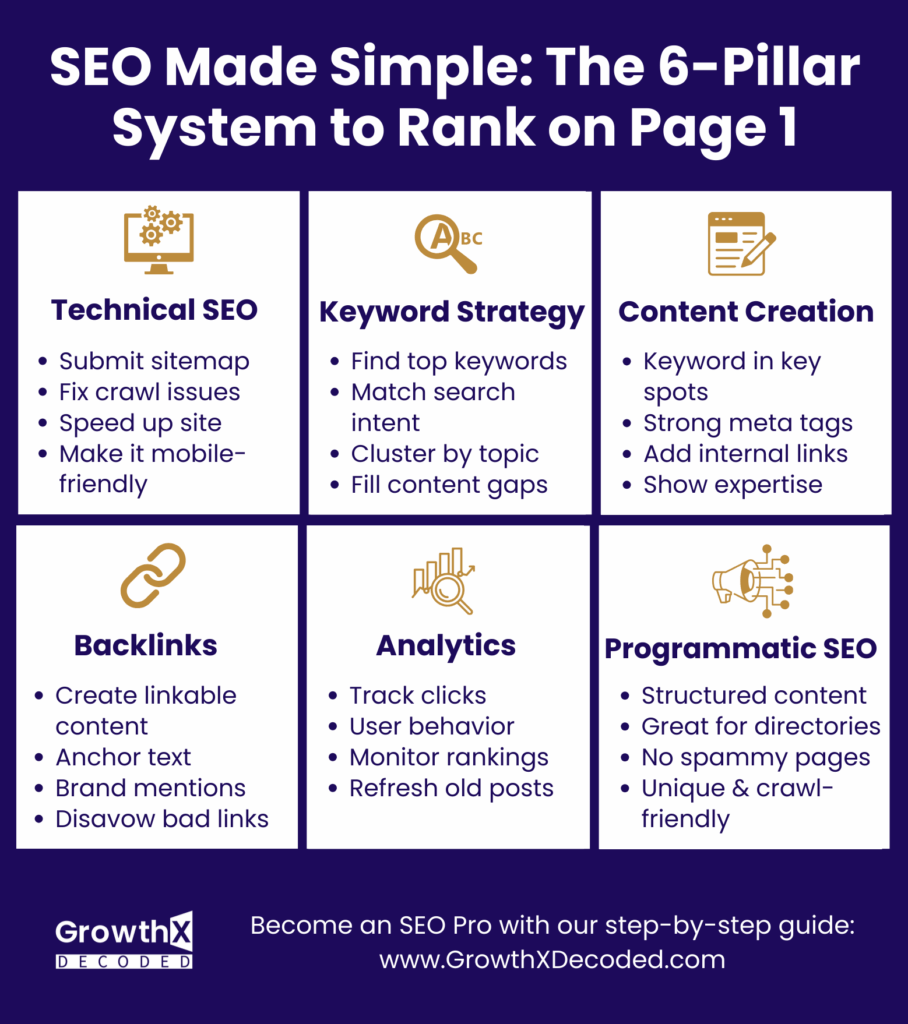
Below, you’ll find all six essential SEO pillars, along with a complete step-by-step guide for each one.
Goal: Make sure your website can be found, loaded, and understood by Google.
a. GSC Setup & Sitemap Submission
Google needs to know your site exists and what pages it should crawl (visit, read, and decide whether to include in search results). That’s exactly what Google Search Console (GSC) does and why submitting a sitemap is step one. A sitemap gives search engines a structured map of your site, increasing the chances that all relevant pages get discovered and indexed.
📌 Example:
If your sitemap is at https://yourdomain.com/sitemap_index.xml, submitting it lets Google start crawling the right pages immediately.
⸻
b. Crawl Settings & Index Control
It’s not enough to publish content: you need to ensure Google is actually allowed to visit and index it. If many of your pages aren’t appearing in search results, the issue could be in how your crawl settings are configured or how your site signals indexing permissions.
📌 Example:
You have 100 articles, but only 30 are indexed. You’ll need to follow specific instructions to check whether your robots.txt file or individual page settings are blocking search engines.
⸻
c. Site Speed Optimization
Page speed is a confirmed ranking factor. Google prefers websites that load quickly, remain stable while loading, and provide a smooth experience for users. Improvements in speed not only impact SEO, but also reduce bounce rates and increase engagement.
📌 Example:
Compress images, remove unused code, and switch to a faster hosting provider if needed. Focus especially on improving speed for your homepage, top-performing blog posts, and landing pages.
⸻
d. Mobile Friendliness
Most organic traffic now comes from mobile devices, and Google indexes your mobile version first. That means mobile usability isn’t optional, it’s a core requirement. Your site needs to function flawlessly on smaller screens.
📌 Example:
Text should be easy to read, buttons should be easy to tap, and the layout must remain clean across devices without users having to zoom in or scroll sideways.
⸻
e. HTTPS / Secure URLs
Security matters for users and for SEO. Google considers HTTPS a minimum standard for ranking, and browsers now warn visitors when a site isn’t secure. Migrating to HTTPS ensures that your site is trusted and compliant.
📌 Example:
If your pages still load on http://, search engines will consider them insecure and may limit their visibility. Make sure every page resolves under https://.
✅ Action: Learn how to set up GSC, submit your sitemap, and ensure your site is crawlable, indexable, fast, mobile-friendly, and secure.
Full story: Technical SEO Guide.Goal: Understand what your audience is searching for — and why — so you can create content that gets discovered and clicked.
a. Keyword Research
The foundation of SEO is knowing which words and phrases your target audience types into Google. These are the search terms your content should match, otherwise, it won’t get found.
📌 Example:
If your audience is searching for “how to write cold emails,” then that exact phrase, not just “email tips” , should appear in your title, headers, and first paragraph.
⸻
b. Search Intent Matching
It’s not just about what people search, but why. Search intent tells you what kind of content Google wants to serve: a tutorial, a list, a product page, etc.
📌 Example:
⸻
c. Topic Clustering
Publishing one article on a topic isn’t enough. Google ranks domains that cover a subject thoroughly. That’s where topic clusters come in: a group of related pages that all link to each other.
📌 Example:
A “Cold Email” cluster might include:
⸻
d. SERP Format Analysis
Before creating content, check what’s already ranking for your target keyword. Google is showing you the preferred format: follow it.
📌 Example:
If top results for “cold email subject lines” are listicles like “21 Subject Lines That Get Replies,” your article should follow a similar list format, not a long essay.
⸻
e. Content Gap Discovery
Content gaps are opportunities: topics or subtopics that your site hasn’t covered yet, but your audience cares about. You find them by studying your competitors, analyzing your own content, and listening to what your users search for. The goal isn’t to copy, it’s to cover what’s missing and do it better.
📌 Example:
Your competitor has a short blog post on “cold emails for job seekers” that ranks well but it lacks templates, examples, or up-to-date insights.
You notice you haven’t touched that angle yet. That’s a content gap you can fill and improve upon by writing a comprehensive, useful guide that wins trust and traffic.
✅ Action: Learn how to find the right keywords, understand what users want, and build content clusters that Google loves.
Full story: Keyword Strategy That Gets You to the Top of GoogleGoal: Write content that Google can rank and people enjoy reading.
a. SEO Titles & Meta Descriptions
These are the first things people see in search results. A good title grabs attention. A good meta description convinces the user to click. Together, they directly impact your click-through rate (CTR).
📌 Example:

⸻
b. Keyword Placement
You’ve found the right keyword now place it where Google expects to see it. This includes your title (H1), first paragraph, subheadings, URL, and image alt text. Don’t overdo it, but don’t hide it either.
📌 Example:
Use cold email tips in your title, in the first 100 words, and once in a header.
⸻
c. Image SEO
Search engines can’t “see” images but they can read filenames and alt text. Descriptive images with clear naming help Google understand your page, and can even rank in Google Images.
📌 Example:
Instead of uploading IMG_0034.jpg, use cold-email-subject-line.jpg and set alt=“Best cold email subject line examples”.
⸻
d. Internal Linking
Group related content and connect it with internal links by adding hyperlinks in each blog post to other topic-related articles. This helps Google understand your site structure and also encourages users to explore more of your content.
📌 Example:
Your article on cold email subject lines should link to your guide on cold email mistakes.
⸻
e. E-E-A-T Signals
Google prefers content that comes from trustworthy, experienced sources. Show your Expertise, Experience, Authoritativeness, and Trustworthiness with visible author bios, credible sources, and a professional tone.
📌 Example:
Include an author bio with credentials, cite real data, and add trust signals like HTTPS and contact pages.
✅ Action: Learn how to structure your content and on-page SEO so that both users and search engines love it.
Full story: On-Page SEO & Content Playbook That Builds Authority
.
Goal: Earn trust from Google by getting quality links from other websites.
a. Link Acquisition Tactics
There are many ways to get backlinks: you can ask directly, contribute on forums like Quora or Reddit, or write guest posts. But the most effective (and scalable) method is creating high-quality content that people naturally want to reference and share.
📌 Example:
You write a comprehensive cold email guide that gets cited by multiple blogs and newsletters without you ever reaching out.
⸻
b. Digital PR
Go beyond blog posts – publish something unique. Think data studies, tools, or thought leadership that people want to link to because it adds value or originality to their own content.
📌 Example:
You release a “2025 Cold Email Benchmarks Report” and industry blogs link to your insights.
⸻
c. Link & Brand Signals
Both how people link to you (anchor text) and where your brand gets mentioned matter. Descriptive links improve SEO context. Brand mentions, even without clickable link, build recognition and authority in Google’s eyes.
📌 Example:
Someone writes “GrowthXDecoded’s SEO system really helped me” on Reddit. That’s a trust signal, even without a hyperlink.
⸻
d. Disavow Toxic Links
Low-quality backlinks from spammy or irrelevant sources can hurt your rankings. If you spot these, you can disavow them using a tool in Google Search Console.
📌 Example:
You find links from gambling or fake directory websites pointing to your homepage. Disavowing them prevents SEO harm.
✅ Action: Learn how to earn backlinks, create link-worthy content, and remove toxic signals.
Full story: Backlink Building Guide
.
Goal: Monitor performance, learn what works, and improve continuously.
a. GSC: SEO Performance Monitoring
Use Google Search Console to track indexing, clicks, and keyword queries. It helps you spot which pages attract attention and which ones need work.
📌 Example:
A blog post gets impressions but no clicks? Time to improve the title or meta description.
⸻
b. GA4: User Behavior Insights
Google Analytics shows how users interact with your site: what they click, how long they stay, and where they drop off.
📌 Example:
High bounce rate? Maybe the intro is too slow, or the design doesn’t hook readers.
⸻
c. Rank Tracking
Track keyword positions over time to see where you’re gaining or losing ground. Free tools or premium ones like Ahrefs and SEMrush can help.
📌 Example:
A post moves from #25 to #7 for “cold email subject lines” – a clear SEO win.
⸻
d. Content Refreshing
Update outdated posts with fresh info, examples, stats, or formatting to keep them relevant and competitive.
📌 Example:
Your 2022 cold email guide needs 2025 data: update it and re-submit in GSC.
⸻
e. Scroll & Click Behavior
Tools like Hotjar or Microsoft Clarity help you see where users click, scroll, and get stuck. Use this to improve page layout and engagement.
📌 Example:
Nobody scrolls past your hero section? Try redesigning that part to boost engagement.
⸻
✅ Action: Learn how to track, analyze, and improve your content based on real user behavior and SEO signals.
👉 Full story: SEO Analytics Guide
.
Goal: Scale your content and traffic using smart automation but only when done right.a. What Is Programmatic SEO?
It’s a strategy where you generate 100s or 1000s of landing pages using structured data and templates. This works well for businesses with repeatable content patterns, like directories, listings, or review sites.
📌 Example:
You run a travel site and create “Best Cafes in [City]” pages for 300 cities using your own internal database.
⸻
b. When Should You Use It?
Not for everyone. Programmatic SEO only works if your site has structured data and repeatable value. If you’re a SaaS review site, job board, or location-based listing, it can be powerful. But never use it just to chase keywords.
📌 Example:
A SaaS review site could build 100s of “Best tools for [industry]” pages based on its product database each with real info and unique value.
⸻
c. Risks & Requirements
If done wrong, it can backfire. Auto-generating large volumes of low-quality, lookalike pages will tank your SEO. It also wastes your crawl budget so even your best, unique pages might not get indexed. Clean data, useful content, strong internal links, and uniqueness are mandatory.
📌 Example:
Auto-generating 500 pages that just swap a single keyword = spam. It also risks pushing Google to ignore your site entirely.
⸻
d. My Personal Recommendation
I don’t recommend fully automatic generation. Instead, I use semi-manual creation of key pages with enough uniqueness which gives better results, avoids penalties, and ensures critical content gets indexed. I’ll show you exactly how I do it in the guide below.
📌 Example:
Build a strong “Best User Acquisition Strategies” page manually instead of 50 watered-down auto-variations like “Best User Acquisition Strategies for Accountants.”
⸻
✅ Action: Learn how to scale content safely — and when to avoid automation.
Full story: Programmatic SEO Guide
Let’s wrap up:
 Loved the story? Share it to inspire others and spark new ideas!


 LinkedIn
 Twitter (X)
 Facebook
 Copy link