Keyword & Search Intent Strategy: How to Build Content Google Actually Ranks

Keyword & Search Intent Strategy: How to Build Content Google Actually Ranks
Once your technical SEO is solid, it’s time to attract the right traffic. That starts with knowing what people search for, why they search it, and how to structure your content around it.
The foundation of SEO is knowing which words and phrases your target audience types into Google. These are the search terms your content should match, otherwise, it won’t get found.
How to do it:
a. Understand the Head, Body & Long-Tail Keyword Strategy
Not all keywords are created equal. This simple framework helps you group keywords by how broad or specific they are and how hard they’ll be to rank for.
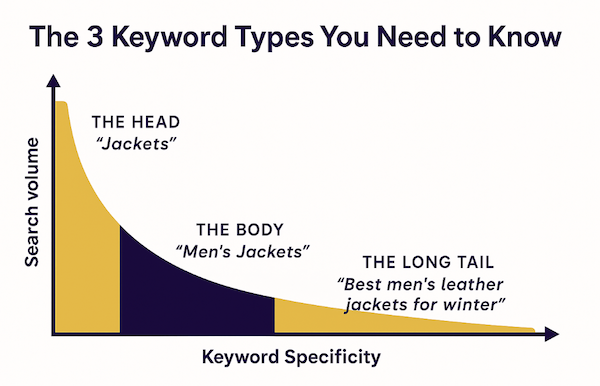
Head Keywords:
• Short, one-word terms (e.g. “jackets”)
• Very high search volume
• Extremely competitive
• Often too vague to convert

Body Keywords:
• 2–3 words (e.g. “men’s jackets”)
• Medium volume but still very competitive
• Better intent, easier to target

Long-Tail Keywords:
• 4+ words (e.g. “Best men’s leather jacket for winter”)
• Lower volume, but higher conversion
• Less competitive
• Perfect for content marketing and SEO blog posts

📌 Long-tail Keywords are ones you should target first with blog posts, FAQs, and supporting articles in topic clusters.
b. Brainstorm Your Keywords
Start by identifying all the search phrases your audience might type into Google. These are your seed keywords.
Use:
📌 Example:
If you offer a cold email service, seed keywords might include:
🔥 Special Hack: Use Google to Uncover Real-World Keywords
Once you’ve listed your initial seed keywords, use Google itself to find what people are actually searching for:
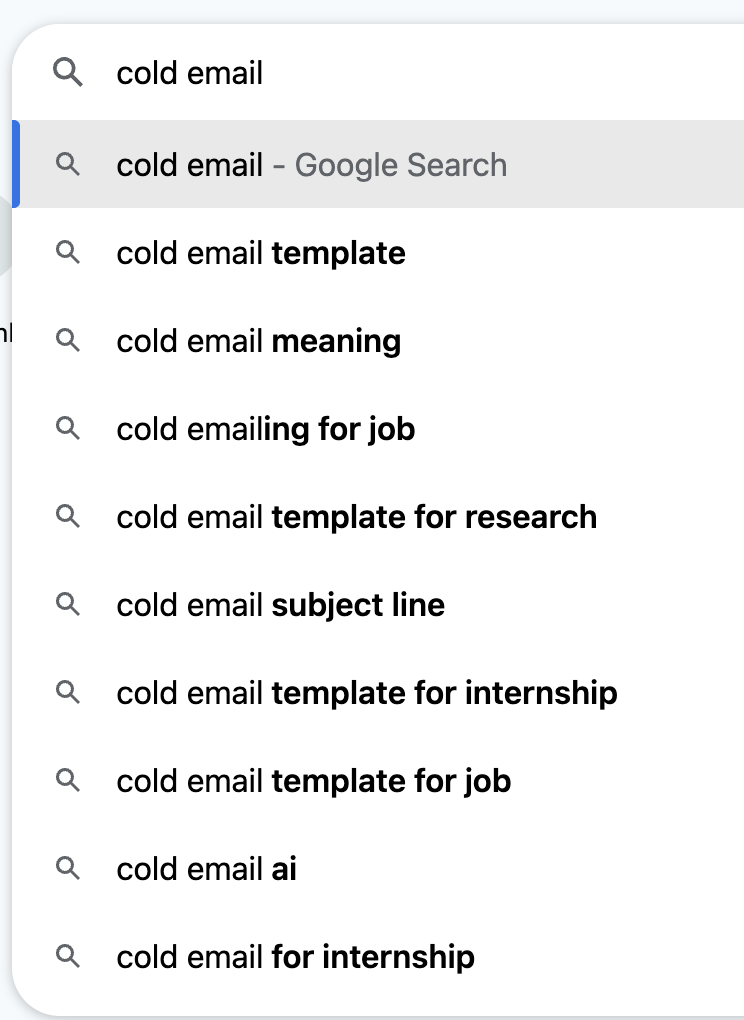
Google Autosuggestions
Type your seed keyword into Google and review the dropdown suggestions. These are based on real user searches and often reveal longer-tail variations, trending topics, and niche ideas you might’ve missed.
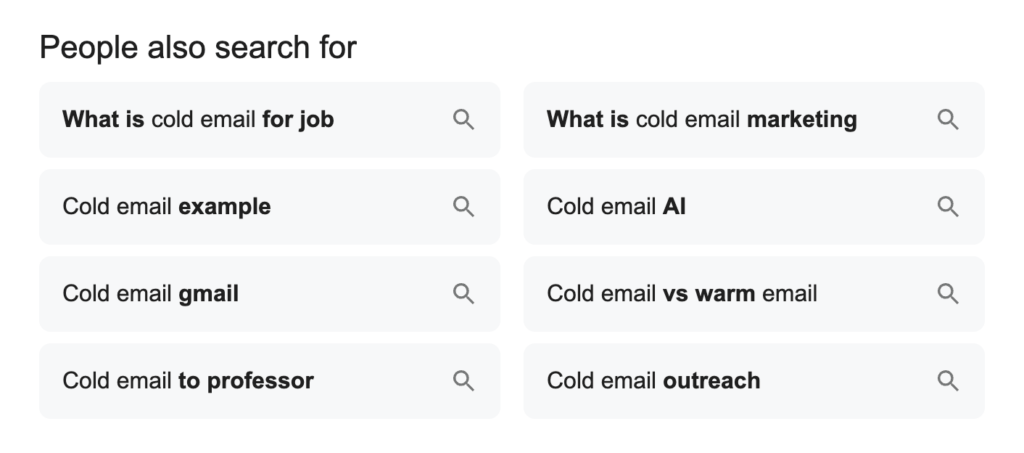
People Also Ask (PAA)
Scroll down the results page to the “People also ask” box. These are common questions related to your keyword: perfect for blog titles, FAQ sections, or subheadings. They also reveal deeper user intent.
Pro tip: Add these long-tail keywords and questions to your keyword list. They’re usually easier to rank for and laser-targeted to what your audience cares about.
c. Upload Keywords to a Keyword Research Tool
Paste your seed keywords into tools like: Moz, Ahrefs, SEMrush, Ubersuggest, LowFruits (great for low-competition keywords)
These tools will give you:
d. Filter for Low-Hanging Fruit
Focus first on keywords that are:
• Search volume: at least 50–500/month
• Keyword difficulty: under 25
• CPC: low to medium (optional, but indicates commercial intent)
These are your low-hanging keywords: easier to rank for and quicker wins.
e. Then Filter for More Competitive Keywords
Once you’ve covered the easy wins, explore more competitive keywords:
These will be harder to rank for, but they’re worth targeting with in-depth guides, comparison articles, or topic clusters that build your authority on the subject.
f. Lastly, Filter for the Most Competitive Keywords
These are high-volume, high-difficulty keywords that your strongest competitors are already ranking for:
They’re tough to win but ideal for creating pillar pages, “ultimate” guides, or link-worthy resources. Focus on these during your content gap discovery phase. Even if you don’t rank immediately, they build topical authority and bring long-term SEO gains.
g. Save Everything in One Place
Create a master spreadsheet with all your keywords, organized into the three categories listed above: Low-Hanging, Harder, and Very Difficult.
h. Pro Tip: Use This Visual Guide
If you want a quick summary, I recommend this keyword research guide. It walks through different tools and strategies clearly:
With a bulk of potential keywords in hand, it’s time to refine them by intent.
It’s not just about what people search, but why. That why is called search intent and it tells you what kind of content Google wants to rank: a tutorial, a list, a product page, etc.
But intent alone isn’t enough. You also need to study the SERP (Search Engine Results Page) because Google shows you the exact formats and content types that are currently winning.
This is one of the most important (and most overlooked) steps in SEO.
📌 Examples of Search Intent + SERP Format:
• “Best cold email tools” → They want to compare products.
Top results: Listicles, comparison tables, affiliate blogs.
• “How to write cold emails” → They’re looking for practical, step-by-step instructions.
Top results: Long-form guides with examples and steps.
• “Cold email examples” → They want copy-paste templates.
Top results: Template libraries, short posts with example sections.
How to Find the Intent & Format
Keyword tools like Ahrefs, SEMrush, or Ubersuggest often try to label keywords as “informational,” “transactional,” etc. Good to check, but don’t rely on them they’re guesses.
The only reliable way is to Google the keyword yourself and study the actual results.
Step-by-Step Instructions:

1. Open your keyword list (start with Low-Hanging and Harder groups).

2. Google each keyword.

3. Look at the top 5–6 search results for each keyword.

4. Ask:
• What’s the format? (Blog post, video, tool, product page, landing page?)
• What’s the angle (style of content)? (Step-by-step guide, comparison, checklist, sales pitch?)

5. Write down your conclusions for each keyword, including the best title ideas and what’s missing from existing content (e.g. visuals, real examples, updated tips).
Write detailed conclusions for each keyword. Include your best title ideas, clearly explain what’s missing in the current top-ranking content (such as visuals, real-life examples, updated statistics, or deeper explanations), and note any gaps in format or structure. The more descriptive and specific you are, the easier it will be later to define strong, original content titles that outperform existing results.
Once you’ve identified formats and gaps, it’s time to build content structure.
Publishing just one article on a topic isn’t enough. Google tends to reward websites that demonstrate authority by covering a subject in depth. That’s where topic clusters come in: a group of related pages that all link to each other.
📌 Example:
If your main topic is Cold Email, your topic cluster might include:
• Cold email subject lines
• Cold email mistakes to avoid
• Cold email follow-up strategy
• Cold email tools comparison
• Cold email templates for job seekers
How to Do It:

1. Pick a core keyword or topic with multiple subtopics (e.g., “Cold Email”).

2. Break it down into 4–6 detailed articles, each covering a specific angle or question.

3. Upon publishing, internally link them using contextual anchor text (not just “click here”), so that both users and Google understand how the articles are connected.Now that you’ve gathered all your keywords, mapped their search intent, and analyzed the SERP formats, it’s time to define your actual content titles.
Quick reminder: you should have a spreadsheet with three tabs (or three separate files), each representing a different keyword difficulty level: Low-Hanging, Harder, and Very Difficult.
Each body keyword should be linked to several long-tail variations (see Step 3: Topic Clustering). For every long-tail keyword, include a row with the following columns:
Keyword, Search Volume, Difficulty (0–100), CPC, Intent, SERP Format, and Gaps in Existing content.
You can either go through the keywords manually, one by one, or to save time, upload your keyword research document into ChatGPT. In ChatGPT, paste your spreadsheet one difficulty group at a time to avoid confusion.
Prompt to Use in ChatGPT:

I’m uploading a list of SEO keywords grouped by difficulty (Low-Hanging and Hard). Each keyword includes search intent notes, SERP format, and gaps in existing content.

Please generate SEO-optimized content titles for each keyword that:
• Match the search intent
• Reflect the preferred SERP format (e.g. guide, list, comparison)
• Fill in gaps from existing content (e.g. lacking visuals, updated info, real examples)

For each keyword, give:
1. Suggested Title
2. Title Format (Guide, Listicle, Comparison, etc.)
3. Notes on how to make the content better than current top results
Once your titles are set, you’re ready to move on to the content creation phase. Below, you’ll find a complete guide to help you create high-quality, SEO-optimized content.
Important: Start with low-hanging content while you build quick wins, then layer in harder targets as you gain organic traction. After you’ve fully covered all the topics from your Low-Hanging and Harder keyword groups, come back to this guide and proceed to Step 5. That step will help you tackle the Very Difficult keywords using advanced strategies.
This step is for your Very Difficult keyword group – where other websites already rank well for the topic, but you believe you can create something better.
It’s the final step in your keyword strategy because it carries more risk: there’s no guarantee Google will consider your version better than the ones already ranking.
How to do it:
1.Analyze competitors using SEO tools (like Content Gap or Competitor Analysis), or simply Google the keyword from Very Difficult keyword group.
2. Open the top 3–4 results and ask yourself:
• Can I make this clearer, more useful, or more visually appealing?
• Are there missing examples, outdated information, or weak formatting?
3. If yes, improve on what’s already working:
• Use the existing title as a base
• Write a new and better version that’s more helpful, updated, and engaging.
That becomes a new article idea for your content plan, designed to beat what’s currently ranking. Loved the story? Share it to inspire others and spark new ideas!


 LinkedIn
 Twitter (X)
 Facebook
 Copy link